
Scene Understanding /
AI agents need answers they can trace to video
Structured scene information lets agents investigate operational questions, compare events, and show the evidence behind each answer.
A station supervisor asks: “Did the ticket-machine queue extend into the passenger circulation path this morning, and for how long?”
A useful answer needs a definition of the queue and circulation path, observations of their spatial relationship over time, and the footage supporting those observations. It also needs a clear boundary between a measured overlap and a claim about its operational effect.
An AI agent can coordinate that investigation. Structured scene information gives it something precise to query; video gives people a way to check the result.
Give the agent a model of the site
In this setting, an agent is a system that uses a language model to select tools and follow up on their results. It might retrieve an occupancy interval, check a configured zone definition, inspect a relevant clip, and revise its answer when the sources disagree. Anthropic’s architectural discussion distinguishes this dynamic use of tools from workflows that follow predefined paths. Routine counts and threshold checks can remain ordinary software. Anthropic, Building effective agents.
The starting point is the structured representation described in Reasoning about scenes with ontologies. The ontology defines concepts such as person, queue, circulation path, observation, and time interval. Site configuration identifies the particular spaces. Observations record which objects were seen where and when, with supporting evidence and quality information.
This lets the agent ask for “intervals when Queue Q1 extended into Circulation Path P1 between 08:00 and 08:20” using a stable definition. It does not have to reconstruct the meaning of the queue and circulation path from every frame or rely on a previous chat summary as the source of truth.
The records need to preserve the distinction between the observed thing and the observation itself. The W3C/OGC SOSA vocabulary provides a useful pattern by connecting observations to their subject, procedure, result, and relevant time. Capture time matters when footage is analyzed later. W3C/OGC, Semantic Sensor Network Ontology, 2017 edition.
Turn a visual relationship into a question
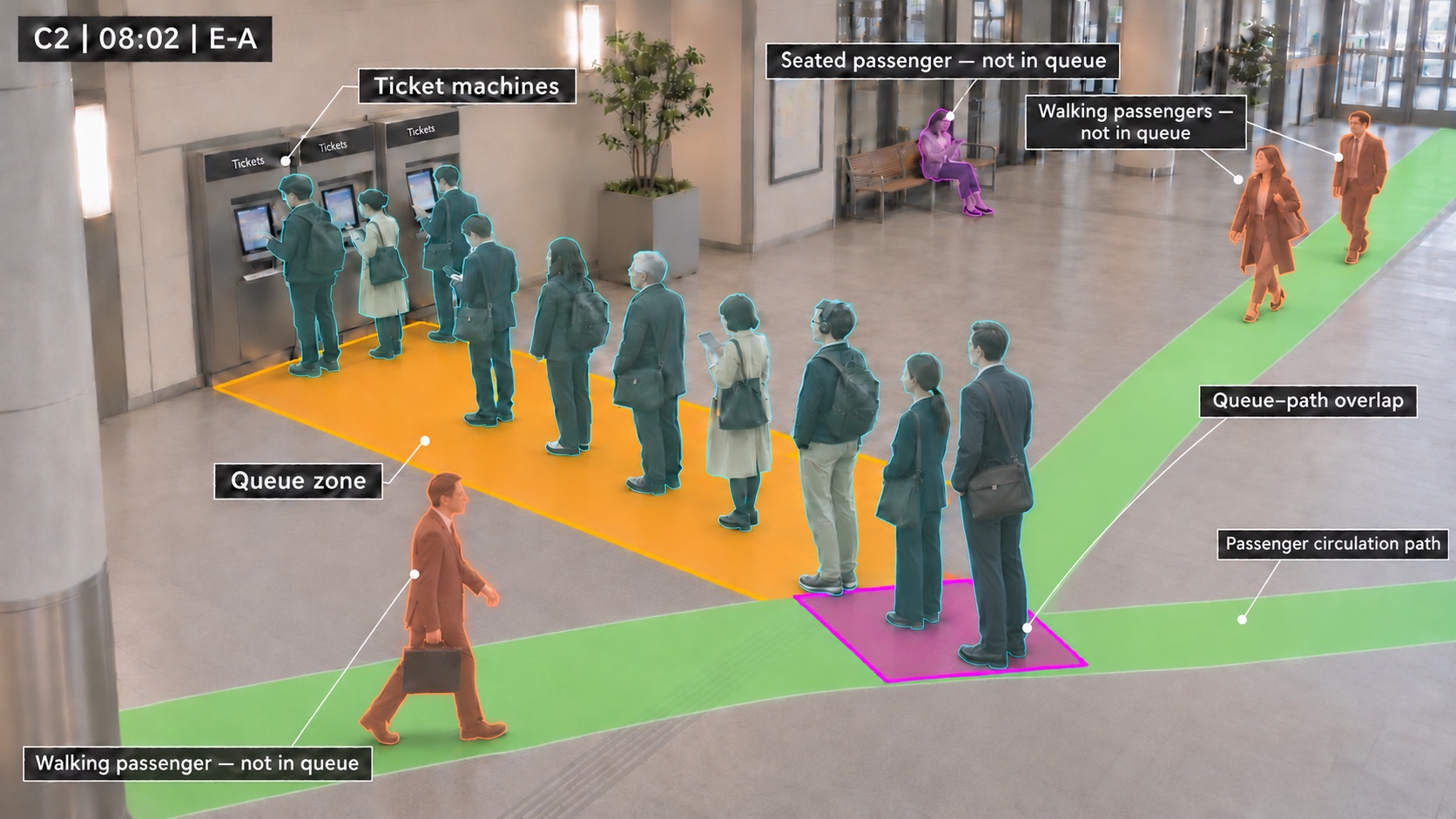
What questions can an agent ask?
Useful questions have a place, a time window, and a definition of the event or measurement being requested.
- State
- Which queues currently extend outside their configured zones? How recent is each observation, and which views are unavailable?
- Sequence
- When did the queue reach the circulation path, recede into its zone, and disperse? Were those transitions visible?
- Overlap
- How much of the queue’s observed duration coincided with an extension into the circulation path?
- Comparison
- Which queue-extension events lasted longer than the site’s configured threshold? Is coverage comparable across shifts?
- Exceptions
- Where did occlusion, a camera outage, or an uncertain track association prevent a complete answer?
- Evidence
- Which frames, clips, measurements, and external records support each statement? What would a reviewer need to check?
Questions about the cause or consequence require additional sources. Video may support a finding that a queue extended into a circulation path. It does not by itself establish that a ticket machine failed or that passengers missed a train. Machine telemetry, service records, and an operator’s account can help investigate those questions; their contributions should remain identifiable.
A worked example: a queue reaches the circulation path
Consider a fictional station concourse on November 12. Camera C2 observes ticket-machine Queue Q1 beside a designated Passenger Circulation Path P1. All times are site-local. The example assumes continuous usable coverage, validated zone boundaries, and a reviewed procedure for distinguishing a queue from people passing through.
For this example, “extends into the circulation path” means the observed queue footprint overlaps the configured circulation path polygon under that procedure. It does not mean the entire route is blocked or establish a safety violation.
The queue is observed from 08:02 to 08:14. It extends into P1 from 08:02 until 08:10, then remains within its queue zone for another four minutes before dispersing. The result is a twelve-minute queue episode with eight minutes of observed circulation path overlap.
The timing narrows the question
A twenty-minute observation window. Bars distinguish queue presence from its spatial relationship to the circulation path.
The agent can now give a bounded answer:
Example answer. Queue Q1 was observed from 08:02 to 08:14. It extended into Passenger Circulation Path P1 for eight minutes, from 08:02 to 08:10, then remained within its queue zone for four minutes before dispersing. Camera C2 supports the finding: E-A records the initial extension, E-B the return within the zone, and E-C the end of the queue episode. These observations do not establish how much anyone was delayed or why the queue formed.
The agent can follow up by checking ticket-machine status or comparing earlier queue episodes under the same definition. It should not turn “queue overlaps circulation path” into “circulation path impassable.” Assessing usable route width or passenger delay requires additional measurements.
How the investigation should work
The agent first resolves the scope: the queue, site, circulation path, measurement definition, and relevant time window. It retrieves the observed intervals and their coverage status. A calculation service computes durations and overlaps from those intervals. The agent then requests supporting footage and any records needed to interpret the result.
Tools should return explicit units, time zones, source identifiers, pagination status, and missing-data conditions. A partial search result must not silently become “all events.” A stale observation must not answer a question about the current scene. If queue membership or continuity is uncertain, the agent should preserve that uncertainty instead of treating every nearby person as part of the same queue.
A frontier model can help decide which question to investigate next and interpret a difficult clip. Situation-specific perception models can maintain recurring observations such as occupancy, crossings, and dwell. Deterministic calculations handle interval arithmetic. This division connects the approach in Where video AI should run to the agent’s investigation: retrieve structured records first, then inspect relevant footage or broader context when needed.
The investigation also needs a stopping condition. If the available observations establish timing but the machine-status record is missing, the answer can report the timing and leave the cause unresolved. Repeatedly asking a model to reconsider the same evidence does not supply the missing fact.
Trace each claim back to its source
Traceability means retaining a chain from a statement to its calculation, input observations, and source media. A fluent explanation of how an agent reached an answer is not enough. A reviewer needs records that can be opened and checked.
An answer should have a return path
The answer identifies the queue, circulation path, time window, and limits of the finding.
Queue present: 08:02–08:14. Its footprint overlaps P1 from 08:02 to 08:10. That interval lasts eight minutes.
Records retain the supporting observations, geometry version, processing version, and continuity checks.
C2 / E-A: extension at 08:02. E-B: queue within its zone at 08:10. E-C: queue dispersed at 08:14. Retain the intervening footage needed to check continuity.
Give each part of the answer an evidence reference
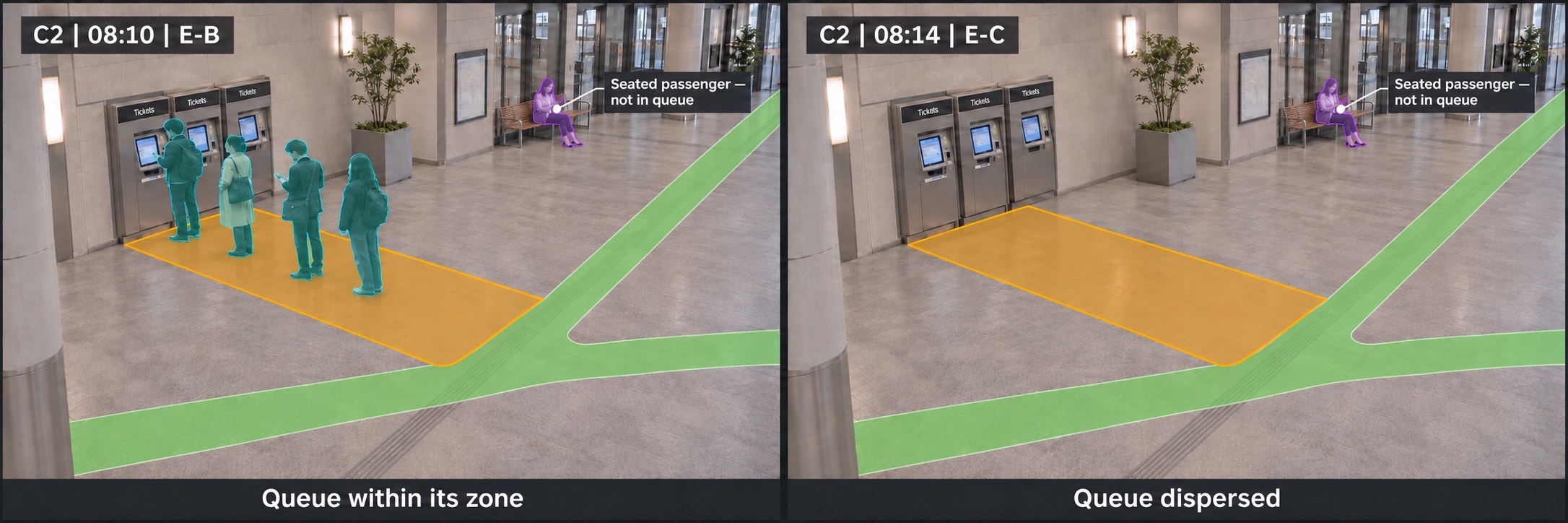
The link from an answer to video should be explicit. Suppose the fictional recording C2-0800 begins at 08:00. A record can retain the following references; offsets below include five seconds of context on either side of each transition.
- E-A · extension observed
- C2-0800, capture time 08:02. Review segment 115–125 seconds. Supports the start observation for “Q1 overlaps P1.”
- E-B · extension ends
- C2-0800, capture time 08:10. Review segment 595–605 seconds. Supports the transition to “Q1 within queue zone.”
- E-C · queue disperses
- C2-0800, capture time 08:14. Review segment 835–845 seconds. Supports the end of the observed queue episode.
- Interval · continuity
- C2-0800, 08:02–08:10, offsets 120–600 seconds. Retain the full interval and coverage checks behind the eight-minute measurement.
These recording identifiers and offsets are invented. In a deployed service, the agent would retrieve them from observation records and return authorized links to the actual media. The links in the example answer above lead to illustrations only.
W3C PROV-O provides vocabulary for expressing derivation: data entities, the activities that produced them, and the people or systems responsible. A scene service can use that pattern to associate an answer with its query result, a measurement with its processing run, and an observation with its source recording. PROV’s term “agent” refers broadly to responsibility; it is not limited to an AI agent. W3C, PROV-O: The PROV Ontology.
For each material claim, an evidence record should retain:
- The assertion and scope: what is claimed, about which object or space, and over what interval.
- The inputs and procedure: observation identifiers, query parameters, model and rule versions, zone configuration, and any external records used.
- The media reference: camera and recording identifiers, capture timestamps, and offsets into the original recording, with a mapping for any trimmed or transcoded copy.
- The limitations: gaps, uncertain associations, review status, and whether the underlying footage remains available.
A timestamped link is one part of this. W3C Media Fragments defines temporal addressing such as #t=120,150, identifying the segment from 120 to 150 seconds in a media resource. Those offsets must be mapped to the recording’s capture times, and playback behavior must be verified in the chosen player. The fragment itself does not authenticate or preserve the recording. W3C, Media Fragments URI 1.0.
Short clips make review faster, but entry and exit frames alone cannot establish a continuous spatial relationship. The service should retain access to the relevant interval and its coverage record, including enough context to challenge the interpretation. If the footage has expired under the retention policy, the answer should say that direct visual verification is no longer available.
Evaluate the answer and its evidence together
A useful evaluation set includes complete events, blocked views, conflicting zone definitions, track breaks, stale observations, and missing recordings. Check whether the agent asks the right follow-up question and stops when the evidence runs out.
Measure the correctness of the reported intervals and calculations, whether each citation supports its associated claim, and whether unresolved cases remain unresolved. Review retrieval as well as generation: an accurate summary of an incomplete event search can still give an incorrect operational answer.
For the concourse example, success means reporting the twelve-minute queue episode, eight-minute overlap, and four minutes within the queue zone accurately. A claim that “the circulation path was completely blocked for eight minutes” should fail unless the evidence and measurement definition actually establish that condition.
Structured scene information makes these investigations possible across many cameras and repeated events. The practical standard is straightforward: an operator should be able to follow an answer back through the measurements to the footage, inspect the assumptions, and correct the finding when the evidence warrants it.
Sources and scope
The concourse scenario, identifiers, durations, and diagrams are illustrative. The annotated images are AI-generated examples, not real footage or measured segmentation outputs. They describe a proposed architecture, not measured Parallel Sight performance or currently deployed agent tools. The linked CSV contains the invented chart inputs. The sources below support the architectural patterns and standards discussed.
- Anthropic — Building effective agents. Architectural distinction between fixed workflows and agents that select tools dynamically.
- W3C/OGC — Semantic Sensor Network Ontology, 2017 edition. Observations, procedures, results, and observation times.
- W3C — PROV-O: The PROV Ontology. Provenance and derivation relationships.
- W3C — Media Fragments URI 1.0. Addressing time segments within media resources.